
A Complete Guide to Efficient, Safe and Reliable Heating System Design
Reading Time: 12 minutes
Introduction
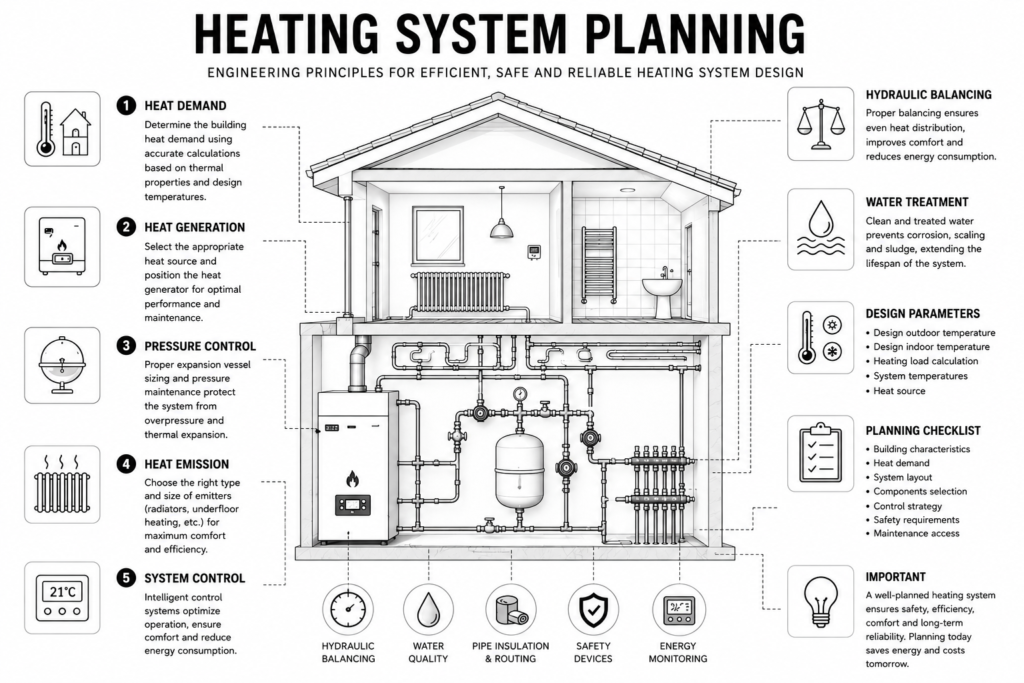
Every successful heating installation starts with careful planning.
Whether designing a residential heating system, a commercial boiler plant, or an industrial heating installation, the planning phase determines the efficiency, reliability, safety, and operating costs of the entire system.
A professional heating design considers far more than simply selecting a boiler. Engineers must evaluate the building, its thermal performance, heating demand, system components, controls, maintenance requirements, and long-term operation before installation begins.
Proper planning helps avoid costly mistakes while improving comfort, energy efficiency, and equipment lifespan.
Why Planning Matters
Poor planning often results in:
- Oversized boilers
- High energy consumption
- Poor temperature control
- Hydraulic imbalance
- Increased maintenance
- Shorter equipment life
- Higher operating costs
Good engineering minimizes these risks from the beginning.
Key Planning Considerations
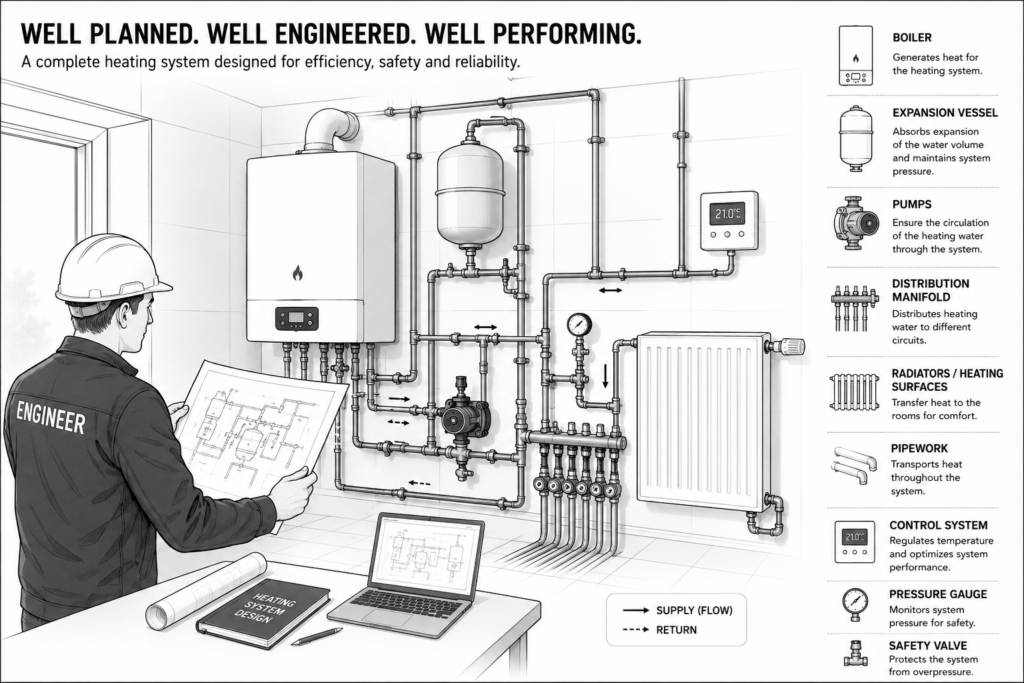
Before a heating system is designed, engineers should gather all necessary project information.
Important questions include:
- What type of building is being heated?
- What are the thermal characteristics of the building?
- Which energy source will be used?
- What level of comfort is required?
- Who will operate and maintain the system?
These decisions influence every part of the design.
Building Heat Demand
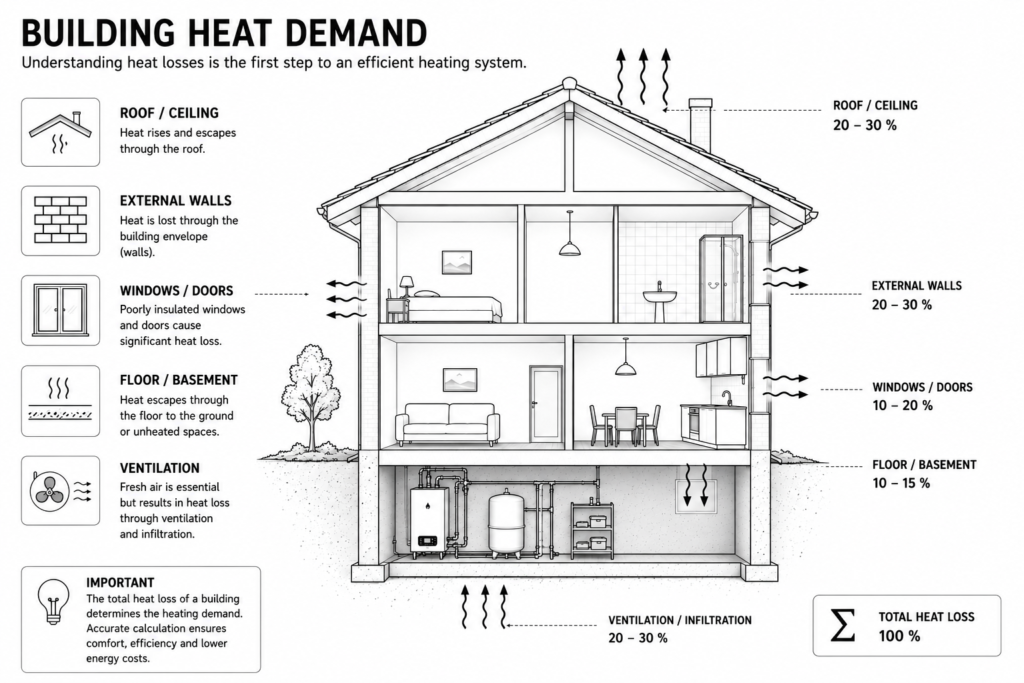
One of the first design tasks is determining the building’s heating demand.
Several factors influence the required heating capacity:
- Building insulation
- Window performance
- Air leakage
- Building orientation
- Outdoor design temperature
- Indoor design temperature
- Occupancy
Accurate heat load calculations prevent oversized or undersized heating systems.
Choosing the Right Heat Source
Selecting the appropriate heat source depends on:
- Energy availability
- Building type
- Investment cost
- Operating cost
- Environmental impact
- Local regulations
Typical heat sources include:
- Gas boilers
- Oil boilers
- Heat pumps
- Biomass boilers
- District heating
- Electric heating
- Solar thermal systems
Each technology has different advantages depending on the project.
Boiler Room Planning
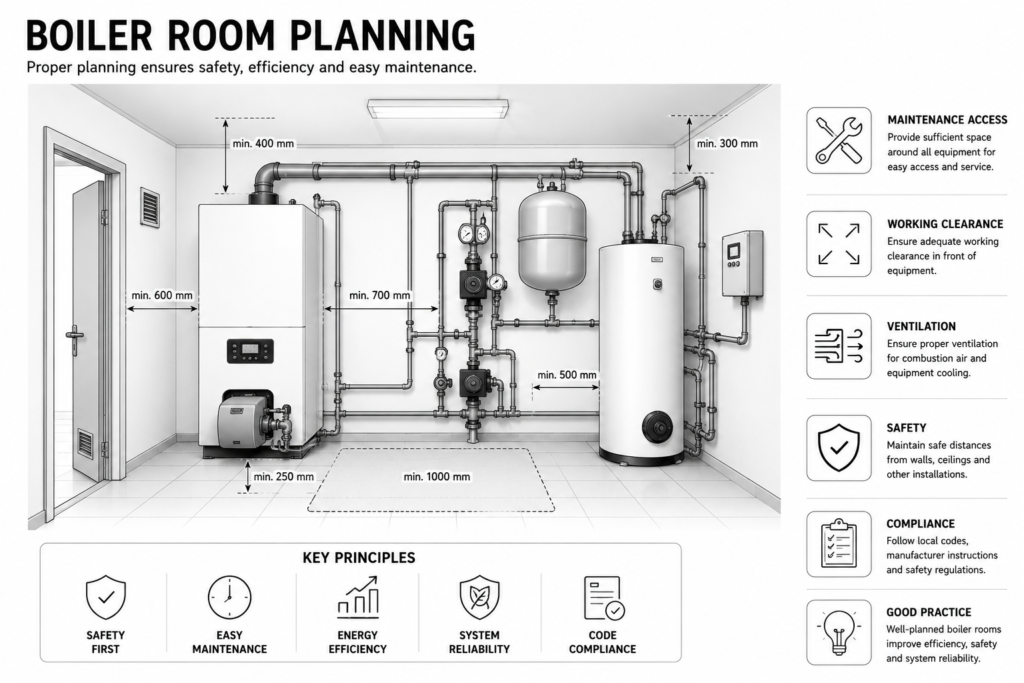
The location of the heat generator is equally important.
Good planning should consider:
- Easy maintenance access
- Safe installation
- Ventilation
- Combustion air supply
- Flue gas routing
- Equipment replacement space
- Future servicing
Poor accessibility increases maintenance costs throughout the building’s life.
Expansion and Pressure Control
Every closed heating system requires proper pressure management.
Engineers should determine:
- Expansion vessel size
- Filling point
- Pressure gauge location
- Safety valve location
- Pressure maintenance method
Proper pressure control protects the heating system from damage caused by thermal expansion.
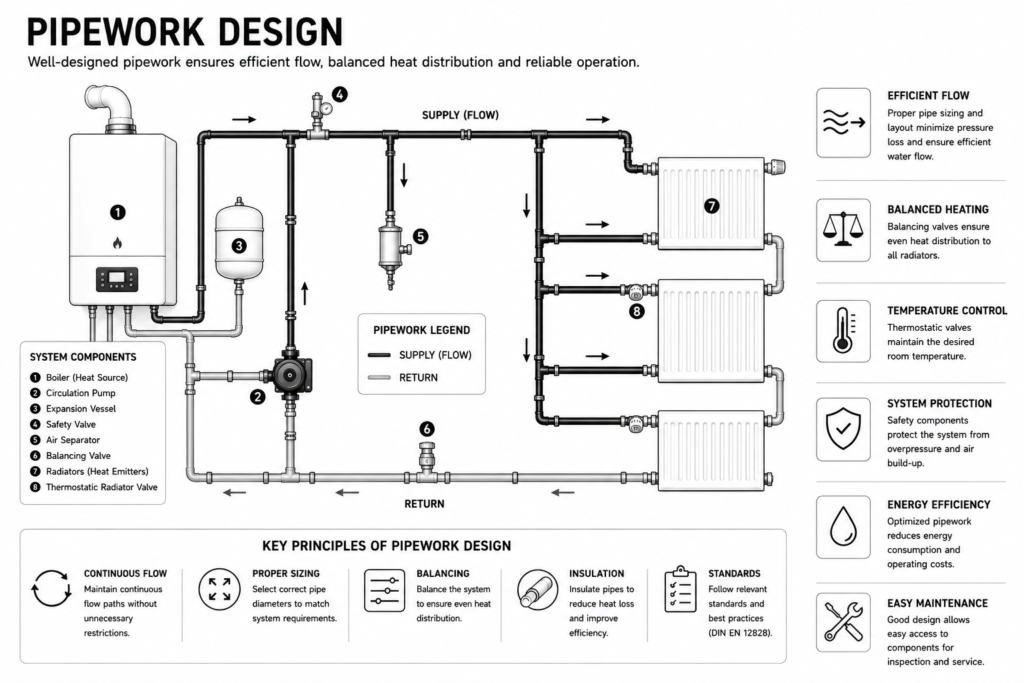
Pipework Design
Pipe routing significantly affects system performance.
Important considerations include:
- Pipe sizing
- Material selection
- Insulation
- Flow velocities
- Installation method
- Accessibility
- Future maintenance
Proper pipe layout improves efficiency while reducing pumping energy.
Hydraulic Balancing
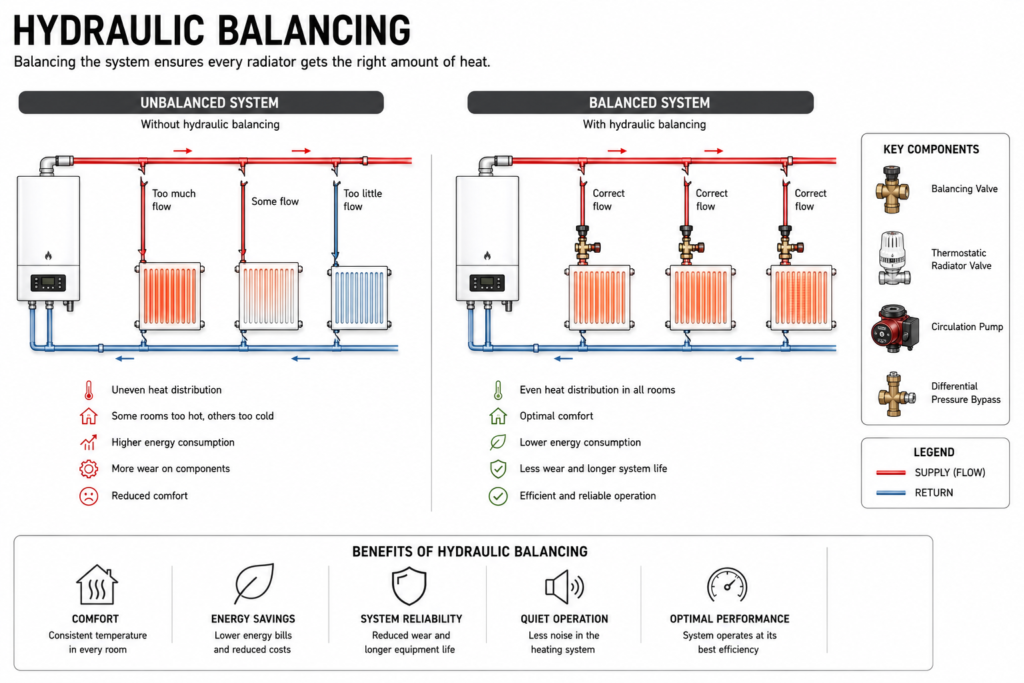
Hydraulic balancing ensures every heating circuit receives the correct flow rate.
Without balancing:
- Some rooms overheat.
- Others remain cold.
- Pumps consume more electricity.
- Boilers cycle unnecessarily.
Correct balancing improves comfort while reducing energy consumption.
Heating Controls
Modern heating systems rely on intelligent control systems.
Typical control functions include:
- Outdoor temperature compensation
- Room temperature control
- Frost protection
- Night setback
- Weather compensation
- Domestic hot water control
- Pump control
Automation significantly improves energy efficiency.
Water Quality
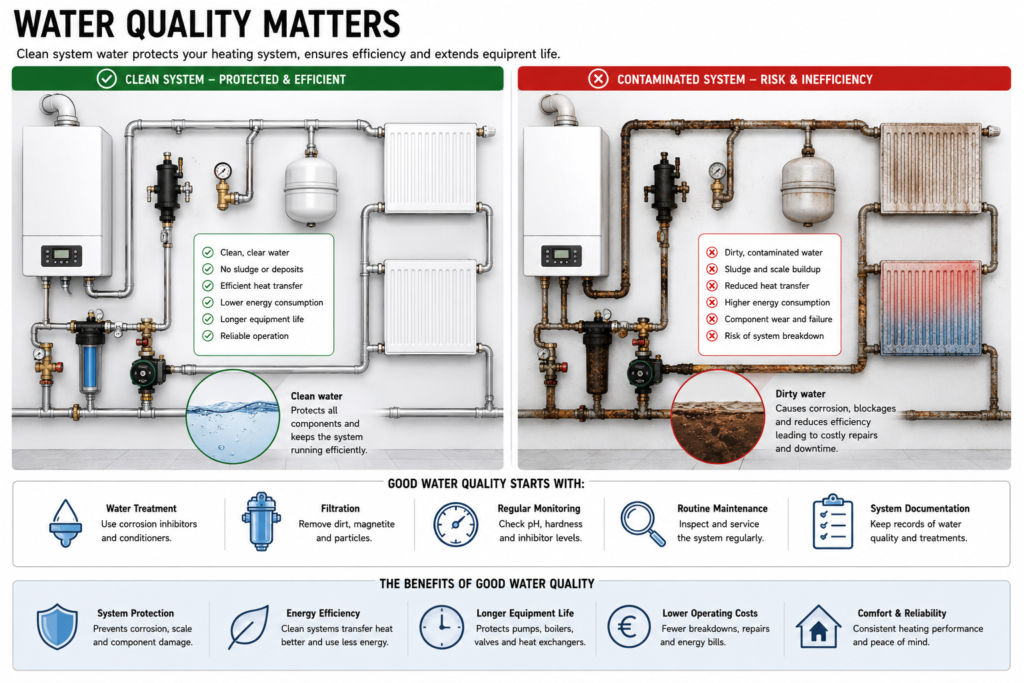
Water quality directly affects heating system reliability.
Poor water quality may cause:
- Corrosion
- Scale formation
- Sludge
- Reduced efficiency
- Equipment failure
Professional water treatment protects the entire installation and extends component life.
Energy Measurement
Modern buildings increasingly require energy monitoring.
Typical measurements include:
- Heat energy
- Electricity consumption
- Pump energy
- Boiler efficiency
- Domestic hot water energy
Energy monitoring supports optimization and maintenance.
Common Design Mistakes
Many heating problems originate during planning rather than installation.
Typical mistakes include:
❌ Incorrect heat load calculations
❌ Oversized boilers
❌ Undersized pipework
❌ Poor boiler room accessibility
❌ Missing hydraulic balancing
❌ Incorrect expansion vessel sizing
❌ Inadequate water treatment
❌ Poor control strategy
Avoiding these mistakes saves money throughout the system’s lifetime.
Best Practice Checklist
✔ Calculate the building heat load accurately.
✔ Select the correct heat source.
✔ Design accessible boiler rooms.
✔ Size pipes correctly.
✔ Install proper pressure maintenance.
✔ Perform hydraulic balancing.
✔ Treat system water appropriately.
✔ Install intelligent controls.
✔ Measure energy consumption.
✔ Plan for future maintenance.
Frequently Asked Questions
Why is heat load calculation important?
Accurate heat load calculations ensure the heating system is correctly sized, improving efficiency and occupant comfort.
Why is hydraulic balancing necessary?
Hydraulic balancing distributes heat evenly throughout the building while reducing energy consumption and improving system performance.
Why should heating water be treated?
Water treatment minimizes corrosion, scaling, and sludge formation, extending equipment life and maintaining efficiency.
International Standards
Heating system design requirements vary between countries.
| Country / Region | Common Standards |
|---|---|
| 🇩🇪 Germany | DIN EN 12828, DIN EN 12831, VDI 2035 |
| 🇪🇺 Europe | EN 12828, EN 12831 |
| 🇬🇧 United Kingdom | BS EN 12828, CIBSE Guides |
| 🇺🇸 United States | ASHRAE Standards, IMC, IPC |
| 🇨🇦 Canada | CSA Standards, National Building Code |
| 🇦🇺 Australia | AS/NZS Building Services Standards |
| 🇳🇿 New Zealand | NZ Building Code, AS/NZS Standards |
Engineering Note: Specific planning requirements differ by country. Always consult the standards and regulations applicable to the project location before designing or installing a heating system.
Key Takeaways
- Successful heating systems begin with comprehensive planning.
- Accurate heat load calculations are essential.
- Proper equipment selection improves efficiency.
- Hydraulic balancing is critical for comfort and energy savings.
- Water treatment protects the system.
- Modern controls optimize performance.
- Planning for maintenance reduces long-term operating costs.
- International standards provide guidance, but local regulations always apply.
